An architectural promenade through the interior of La Tourette convent.
After the machine for living, Le Corbusier may have invented, with the Couvent de la Tourette, the machine for meditating.
Read moreArchitecture photographer's blog
Photographic reports on heritage architecture
Theorized by the architect Le Corbusier at the end of the 1920s, the ‘architectural promenade’ had been more than sketched out a few years earlier for the La Roche House in Paris.
For the first time, inside a house, an architectural journey is offered thanks to structural elements designed to aid observation.
There are open staircases, a balcony and a walkway offering views of the outside, mezzanines and other openings in the walls, and above all, the essential element of any architectural walkway: the access ramp.
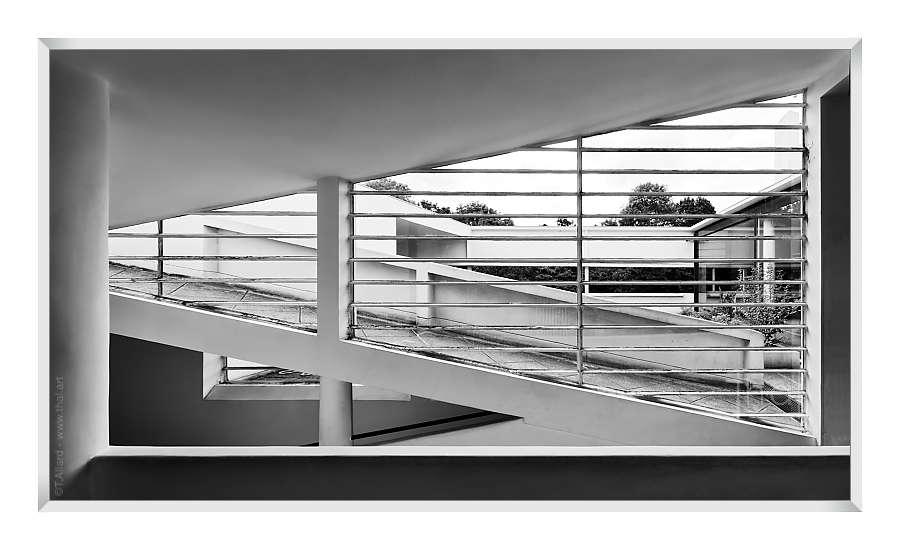
In the early 1930s, Le Corbusier refined his idea for the Villa Savoye in Poissy by increasing the importance of access ramps, both inside and outside, completely looping, with staircases, a path from the ground floor to the roof terrace, and vice versa.
In the staging of his architecture, as proposed by his interior walkways, one cannot ignore the egotistical side that characterizes Le Corbusier and which shines through in his projects, such as his famous Modulor.
His concept has undoubtedly inspired many other architects with strong egos, particularly those who have had the opportunity to design museums, where architecture must compete with the works on display.
It is worth noting that the only access ramp to the La Roche house is located in a collector’s art gallery, as it allows visitors to admire both the art and the architecture.
Since the first half of the 20th century, many museums have featured large interior access ramps or extensive escalator systems, which play a key role in the architectural design.
The main reason for this is not accessibility for people with disabilities (elevators being faster and more efficient).
Very often, before seeing the works, visitors must first pass through a stage of admiration, more related to the architecture of the building and the posterity sought by its designer.
A selection of examples (not exhaustive) throughout history:

In 1932, Giuseppe Momo’s spiral staircase at the Vatican Museum.
In 1959, architect Frank Lloyd Wright’s Guggenheim Museum in New York City served as a precursor to modern museums with its interior spiral ramp that magnifies the architecture and becomes an integral part of the entire visit.
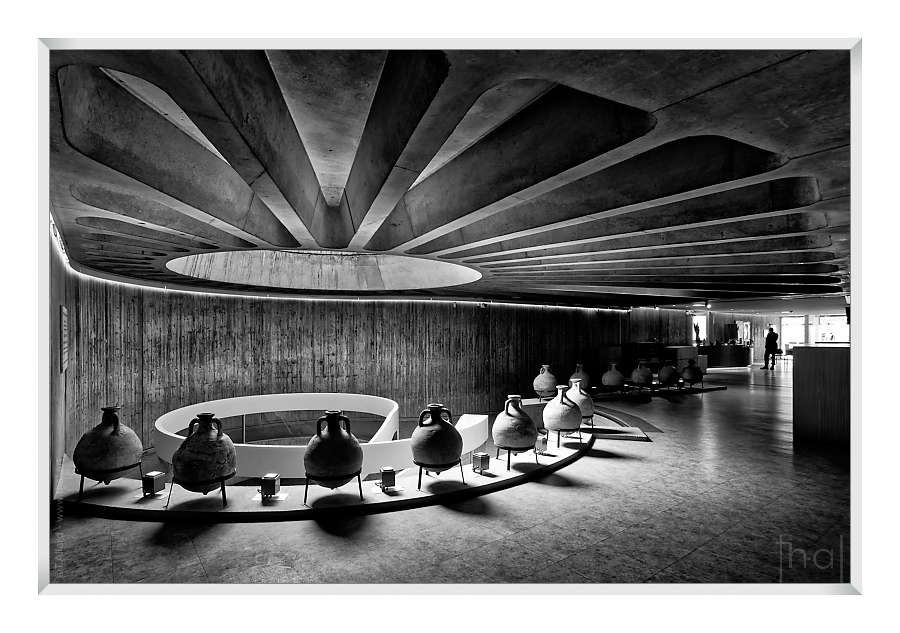
In 1975, in the underground museum of Lugdunum in Lyon, architect Bernard Zehrfuss designed a gently sloping revolving platform with perforations between the levels and spotlights. It remains one of the best examples of an architectural walkway that blends in with the surroundings (archaeological remains).
In 1977, in Paris, the architects of the Pompidou Center, Renzo Piano and Richard Rogers, designed their architectural tour around escalators placed in transparent tubes, which serve as mechanical access ramps.
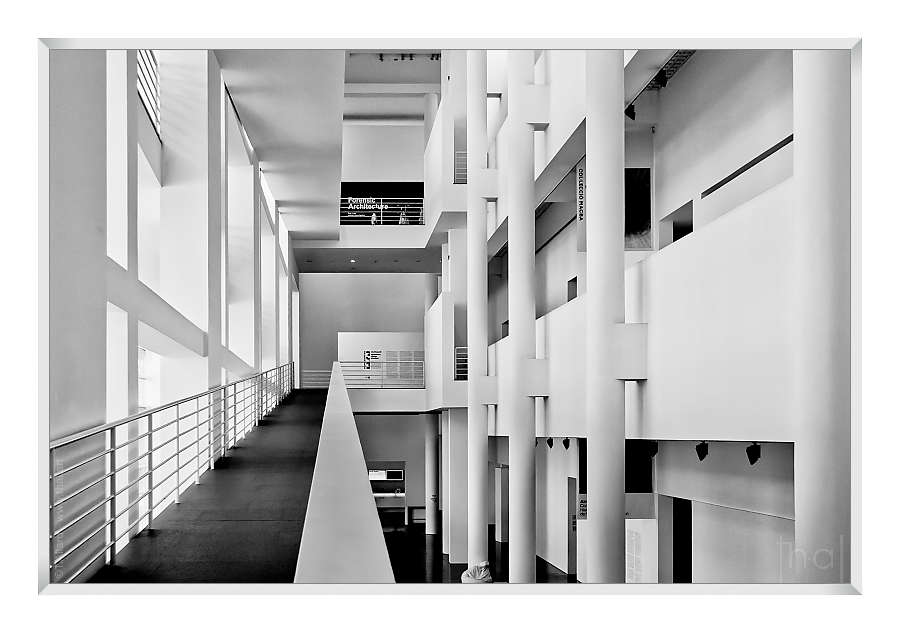
In 1995, the MACBA in Barcelona, designed by Richard Meier, featured a huge continuous access ramp along a glass facade, in a large three-story atrium, which served all exhibition levels.
In 2003, in Zaha Hadid’s MAXXI in Rome, a system of interior ramps and sloping walkways organizes circulation within the ribbon-like concrete volumes, revealing the building’s complex perspectives as visitors walk through it.
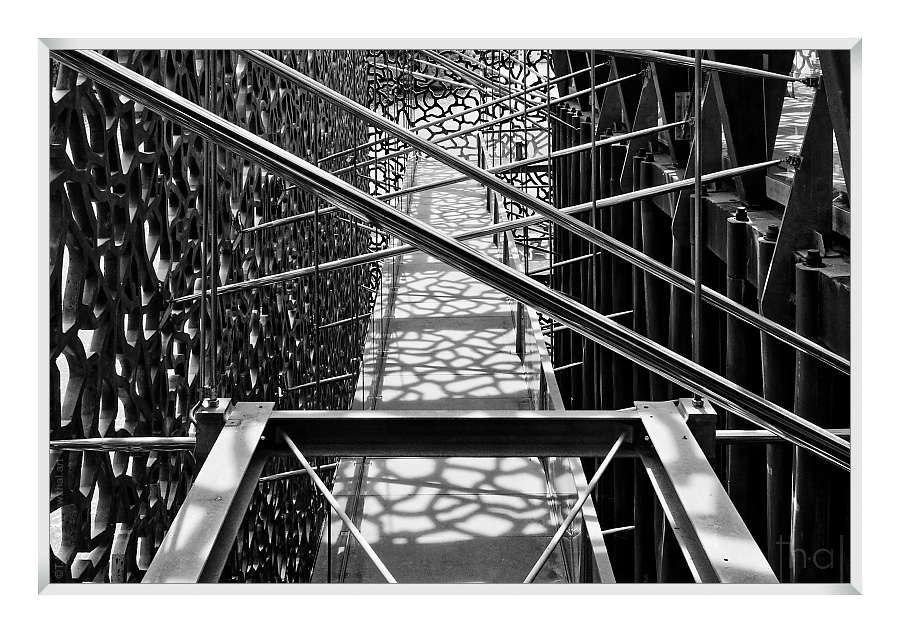
In 2013, in Marseille, Rudy Ricciotti’s architectural walkway at the Mucem almost circles the entire building and is connected to a huge outdoor access ramp that leads to the roof.
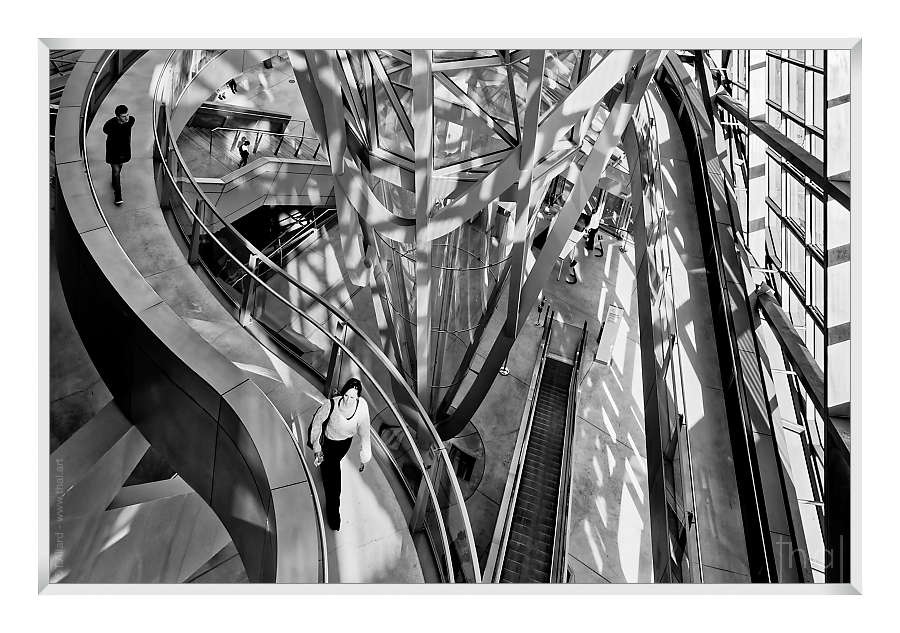
In 2014, amid the deconstructivist chaos of Coop Himmelb(l)au’s Confluence Museum in Lyon (France), the atrium features the full range of modern architectural elements, including a suspended access ramp, large escalators, and open staircases.
In the early 1930s, three years after Le Corbusier’s Villa Savoye and 25 years before the spiral ramp at the Guggenheim Museum, architect Auguste Bossu designed the Chalets de Bizillon in Saint-Étienne, in the Loire region.
Unique in the world, these two six-story buildings were constructed without stairs!
A single circular access ramp, located in a covered inner courtyard, provides access to all apartments and offers residents a kind of architectural promenade.
•••
Articles in this blog mentioning an architectural walk
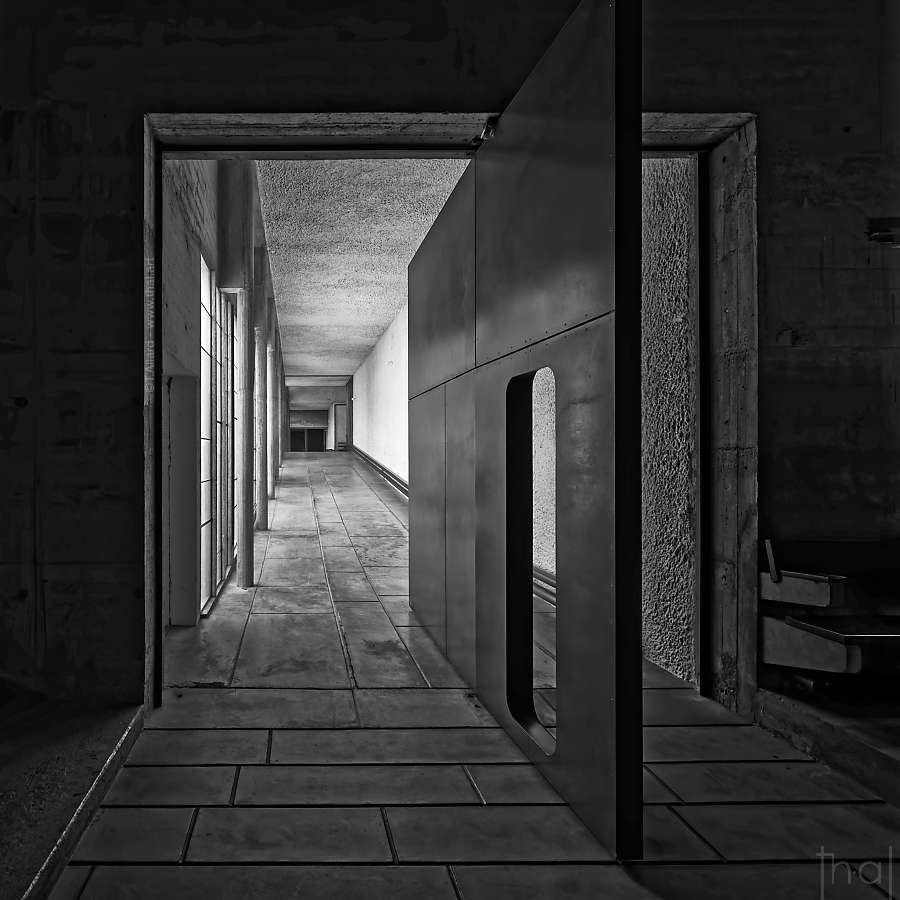
After the machine for living, Le Corbusier may have invented, with the Couvent de la Tourette, the machine for meditating.
Read more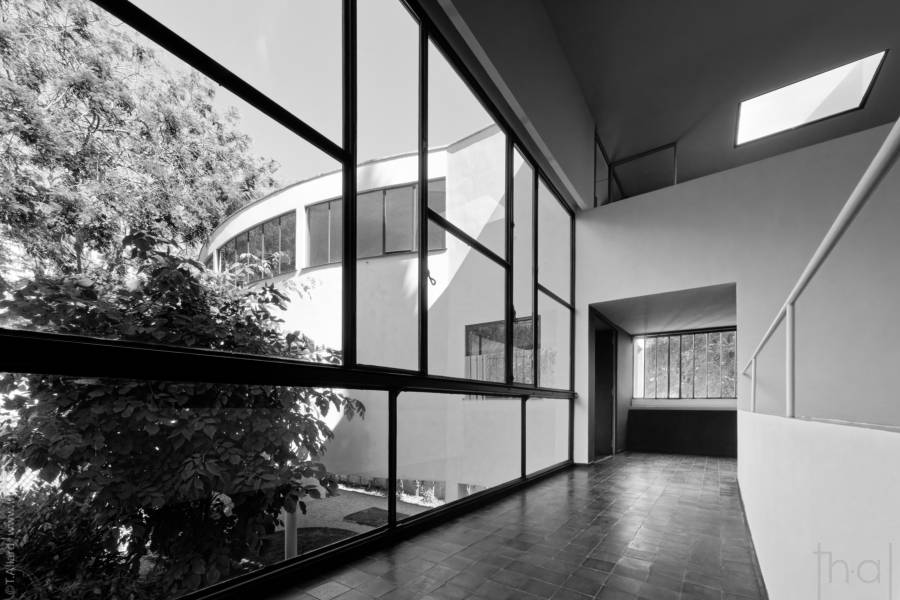
In 1923 in Paris, wealthy collector Raoul La Roche gave Le Corbusier carte blanche to adapt his colorful “purist” art to architecture.
Read more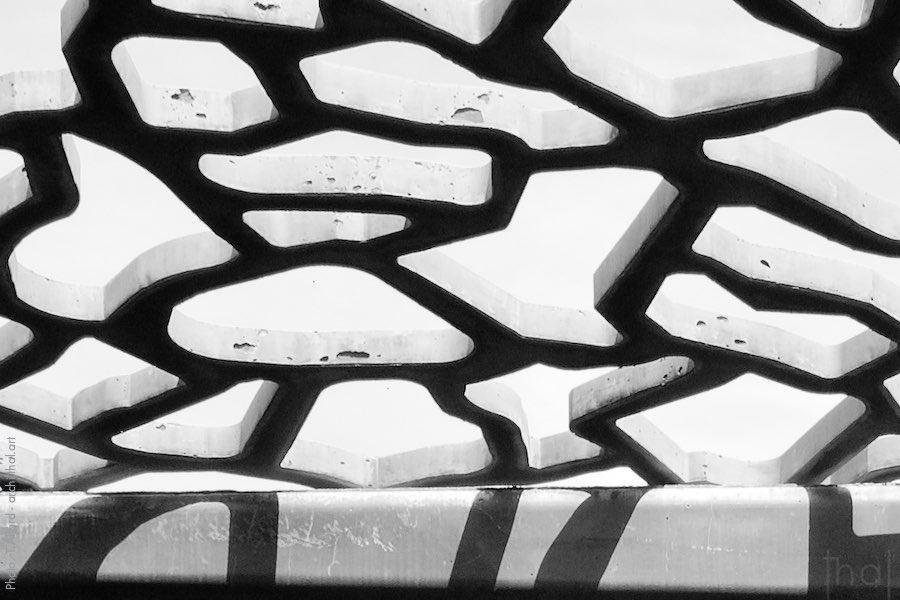
What is hidden behind the apparent lightness of the black mesh veil of the Mucem by architect Rudi Ricciotti?
Read more
In Lyon, France, for the former Museum of Gallo-Roman Civilization, architect Bernard Zehrfuss hid his brutalist architecture inside a hill.
Read more
The interior design of the Villa Savoye by Le Corbusier responds to the architect’s desire to highlight his precepts concerning new architecture.
Read more
30 km west of Paris, the Villa Savoye by architect Jean Jeanneret, known as Le Corbusier, has remained a splendid avant-garde house which was built according to 5 points of architecture.
Read moreTo help me continue to produce new articles and maintain this site : 
•••