After Maison La Roche, Villa Savoye, and Villa Stein-de Monzie, Sainte-Marie de la Tourette Convent can be considered Le Corbusier’s fourth work to embody his concept of an interior architectural promenade.
Although the monumental access ramp, originally designed by Le Corbusier to connect the ground to the top of the building, was quickly abandoned, it was replaced by two ramps entirely glazed on one side, which cross the heart of the building and connect it to the church.
By entrusting the interior circulation of the convent to a young architect, Iannis Xenakis, composer of stochastic (random) music, Le Corbusier added further perceptual dimensions to his architectural promenade.
The alternation of corridors of varying widths and ceilings of varying heights modulates the sound experience of the Dominicans’ journey, while the variety of openings, whether vertical, horizontal, or zenithal, creates a rhythmic light composition, culminating in the famous pans vitrés ondulatoires.
In the traffic lanes, the framed viewpoints mainly allow visitors to admire the architecture of the inner courtyard and, to a lesser extent, the surrounding nature.
Entrance to Le Corbuserie
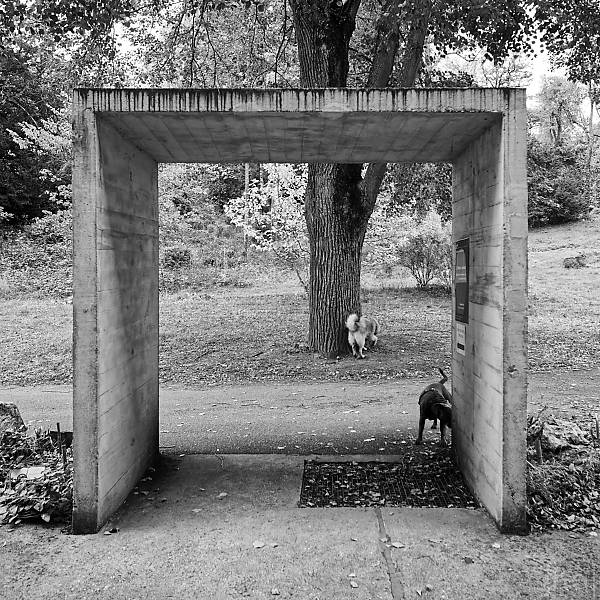
Passing under a welcome archway—a simple concrete structure built to Modulor dimensions—means entering a space governed by strict rules, often derived from mathematics.
Iannis Xenakis uses the Modulor to create the bay windows, as if they were a musical score.
The inner transit of the Dominican friars
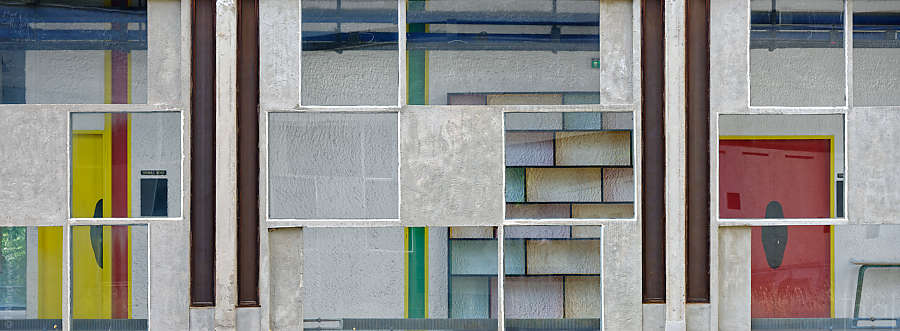
In the La Tourette convent, architectural exploration often blends with contemplation.
The five points of Le Corbusier’s modern architecture offer freedom to compose with the size and shape of the windows that line the many corridors on the façade, making it possible to modulate the light.
These corridors sometimes allow the Dominican friars to be “conditioned” by reducing distractions near their cells, or, on the contrary, by amplifying their spirituality as they approach the spaces for meetings and prayer.
Light’s corridors
The first access ramp
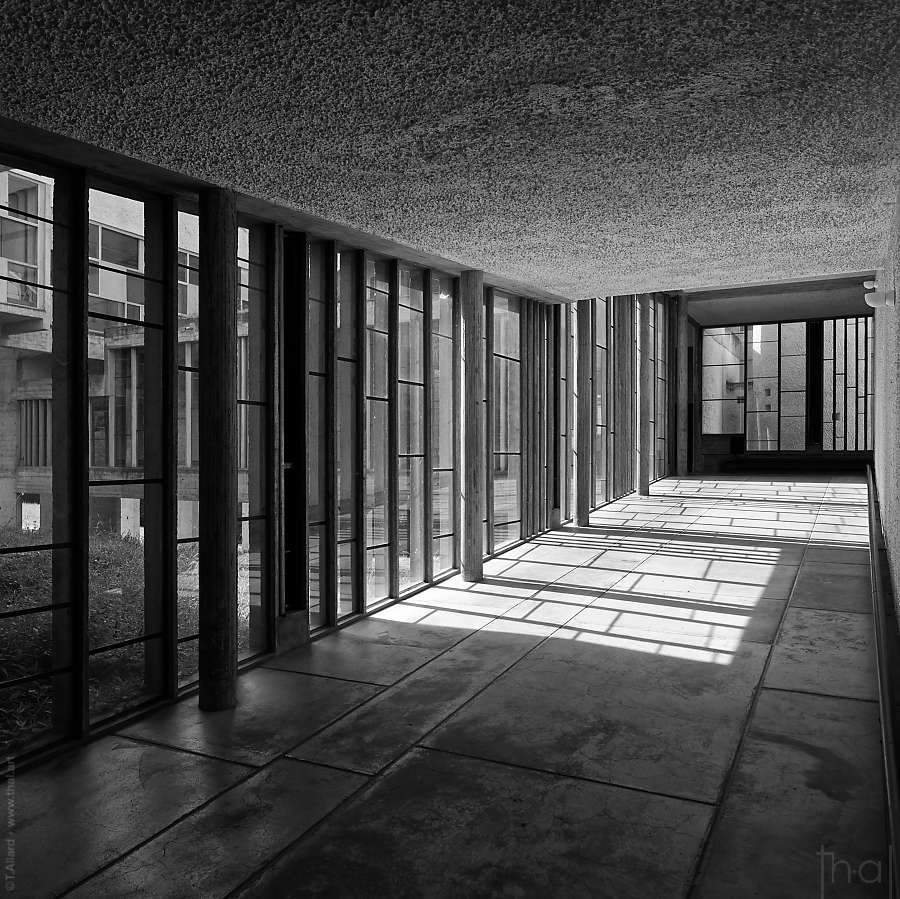
After passing through the entrance to the convent, visitors descend a modest staircase to take the first central access corridor, which slopes upward, crosses the convent courtyard, and allows visitors to appreciate the architecture of the south wing on stilts.
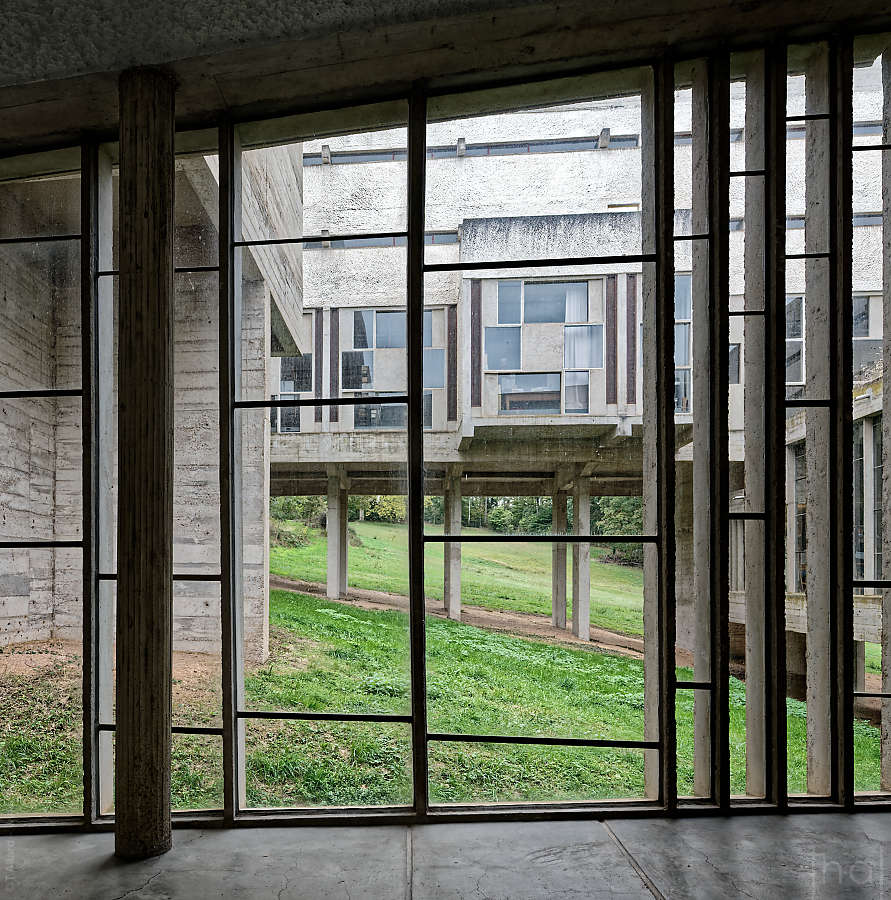
The bay window is segmented by alternating vertical strips and thin horizontal divisions, which constitute the principle of Iannis Xenakis’s undulating glass panes.
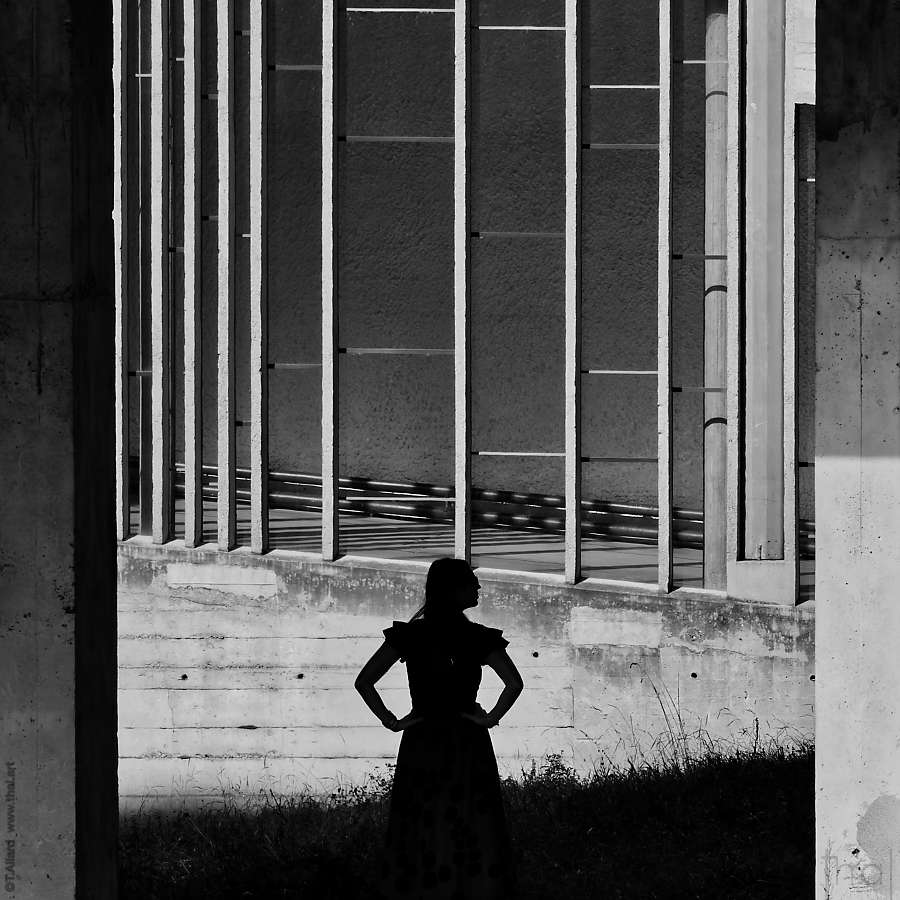
From the outside, the stilts open up a view of the covered access ramp, which serves as a cloister.
At the end of this first corridor is an atrium that leads to the refectory and the chapter house.
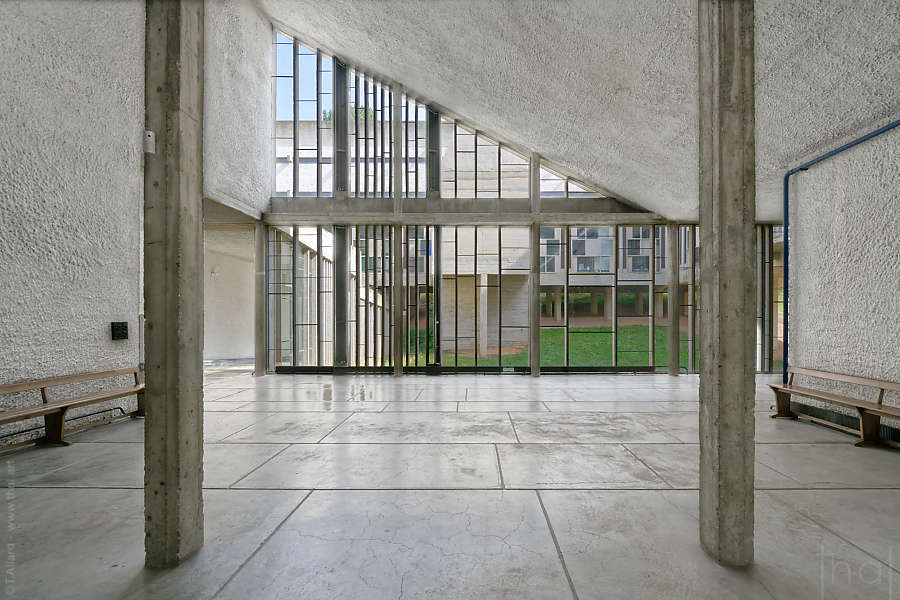
A raised triangular roof increases the height of its bay window, which faces a small chapel whose base resembles a cross.
The second access ramp
On the west side, a second “cloister corridor,” perpendicular to the first, crosses the courtyard toward the church.

Seen from the outside, you can clearly see the “undulating vibration” of the glass facade, which could be compared to the strings of a harp being played.

La pente descendante, par un effet constructif, s’accompagne d’une élévation progressive du plafond, invitant à une élévation spirituelle avant d’entrer dans l’église.
The Mondrianesque corridors
On the middle level of the building, the courtyard circulation offers a view through a geometric glass composition inspired by the works of Piet Mondrian.
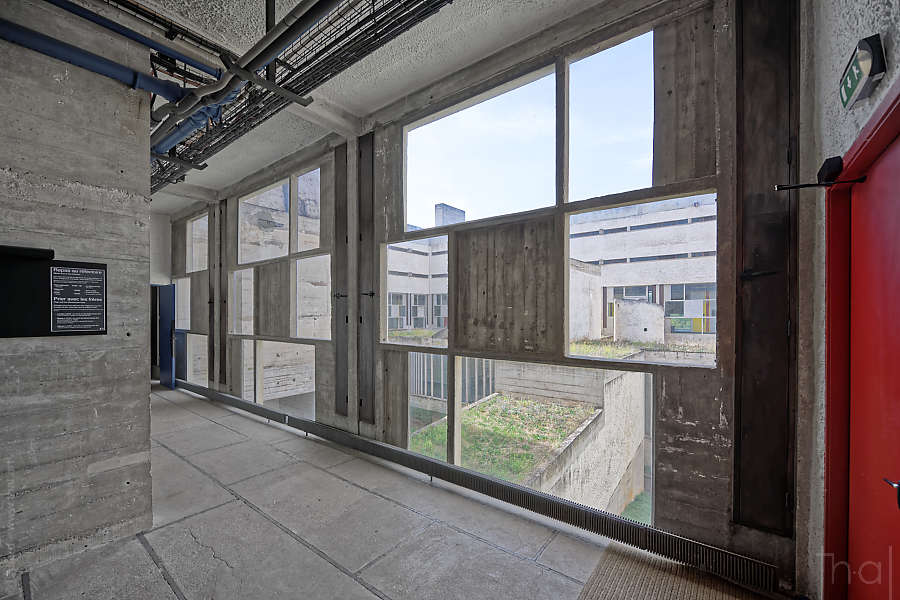
For Xenakis, these screens are similar to a rhythmic grid, alternating between empty and solid spaces.
As with the undulating glass panels, their assembly is calculated using the Modulor.
Spiritual waypoints
The Church of Sainte-Marie de la Tourette
A brutalist masterpiece by Le Corbusier, the Sainte-Marie de la Tourette church was built shortly after the more disruptive Notre-Dame du Haut chapel in Ronchamp, which featured curves that were unprecedented for the architect.
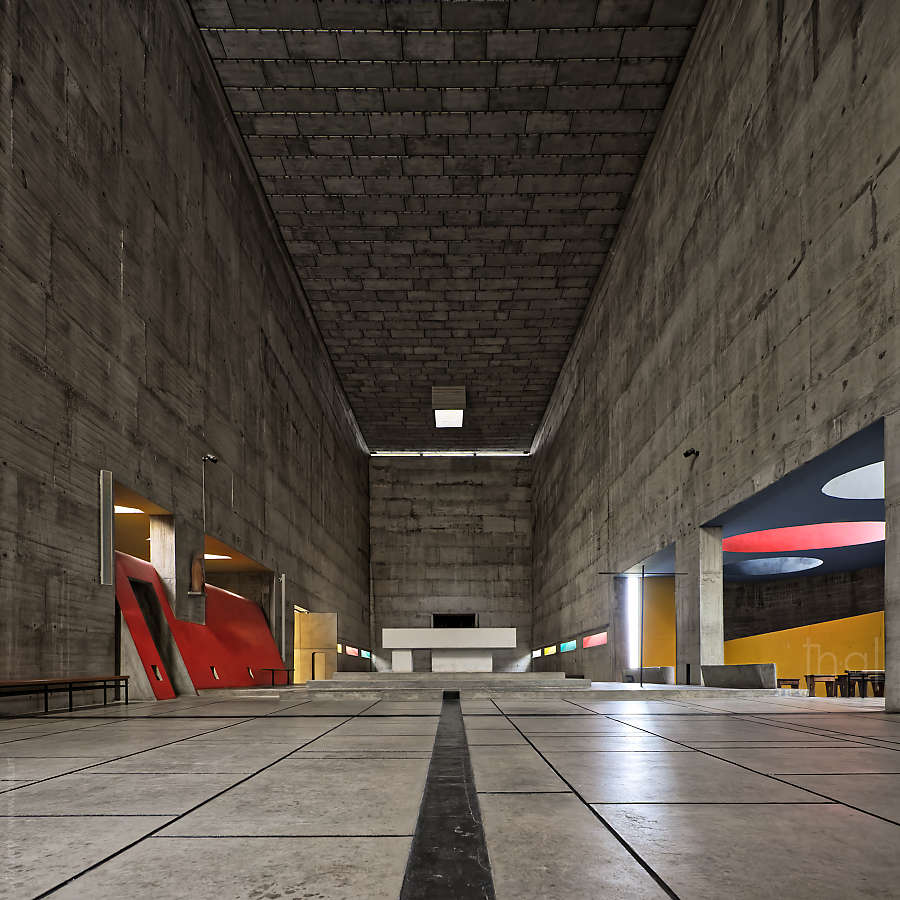
The austerity expected in a place of worship is naturally provided by the building’s envelope, entirely in raw concrete.
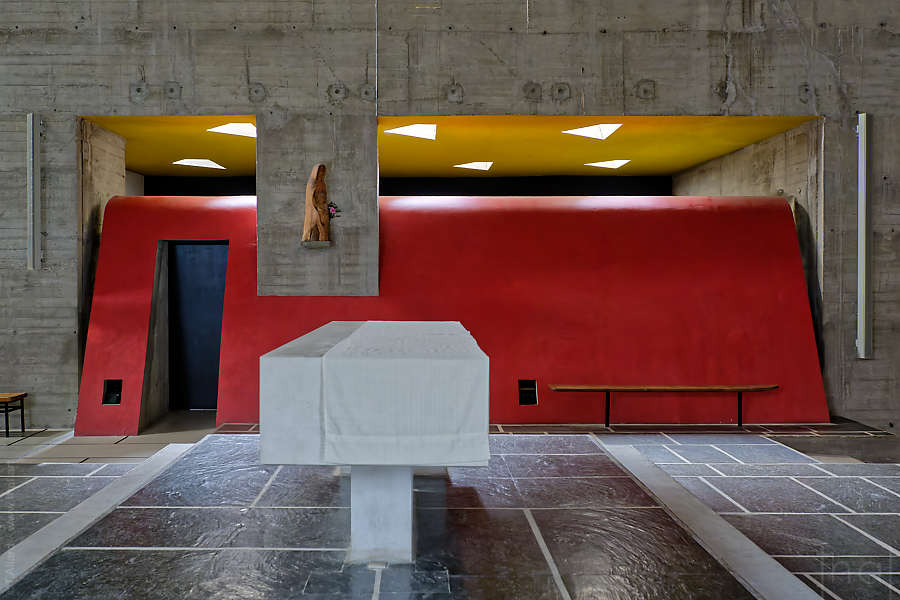
The church takes the form of a parallelepiped onto which two colored elements are grafted on the inside: on one side, a small rectangular volume housing the sacristy, and on the opposite side, a crypt with a more organic shape.
These two volumes complete the church’s layout, which symbolically—and somewhat roughly—forms a cross.

The crypt, partly designed by Iannis Xenakis—notably the large round light cannons—is outlined externally in a shape that, in hindsight, evokes an ear.
An interpretation that gives meaning to a space dedicated to multiple altars, receiving prayers.
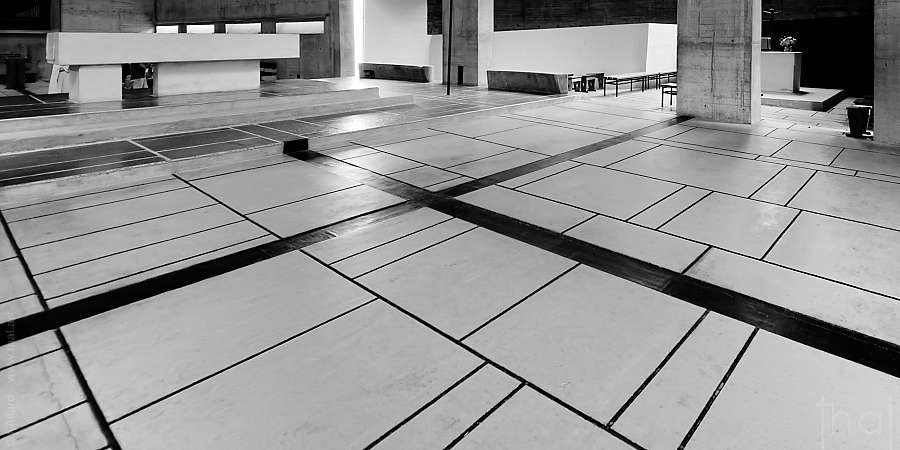
The attention to detail can be seen in the tiling, which echoes the undulating glass panels and clearly incorporates the symbolism of the cross, omnipresent in Le Corbusier’s convent.
The Chapel
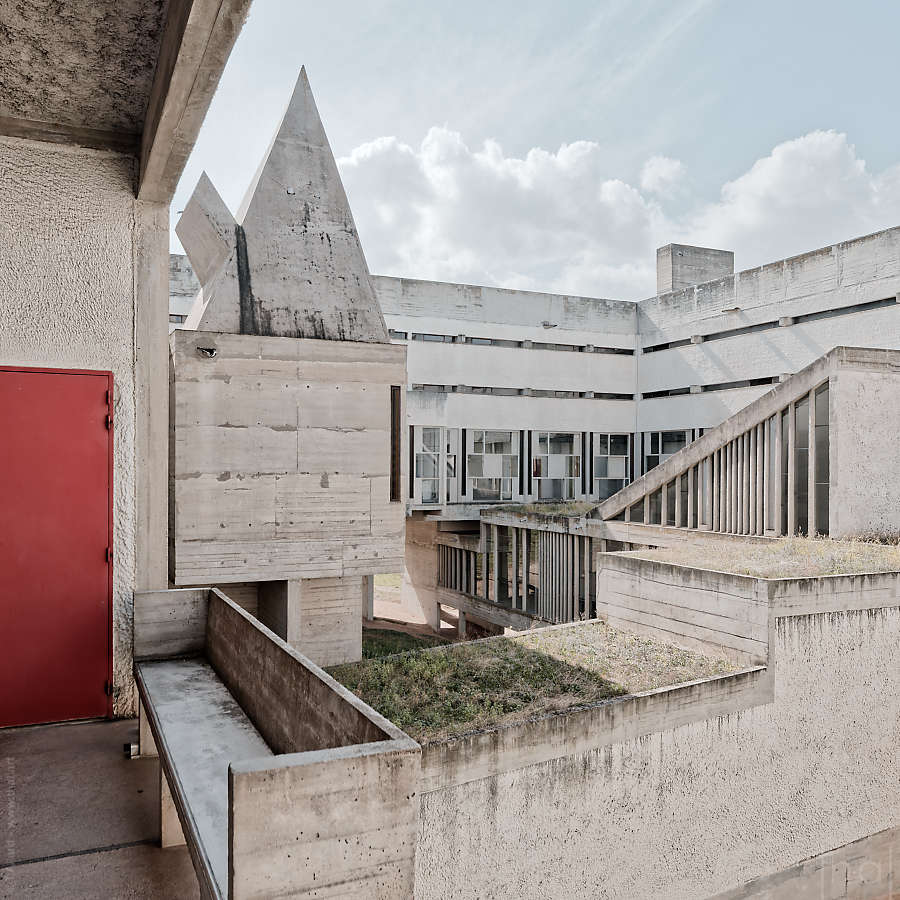
With its triangular roof and a light shaft protruding from the slope—a design principle that would later be used for the church in Firminy—the convent chapel, built on two cross-shaped foundation walls, contributes to the formal chaos of the courtyard.
Its entrance, accessible only from inside, is located near the main entrance.
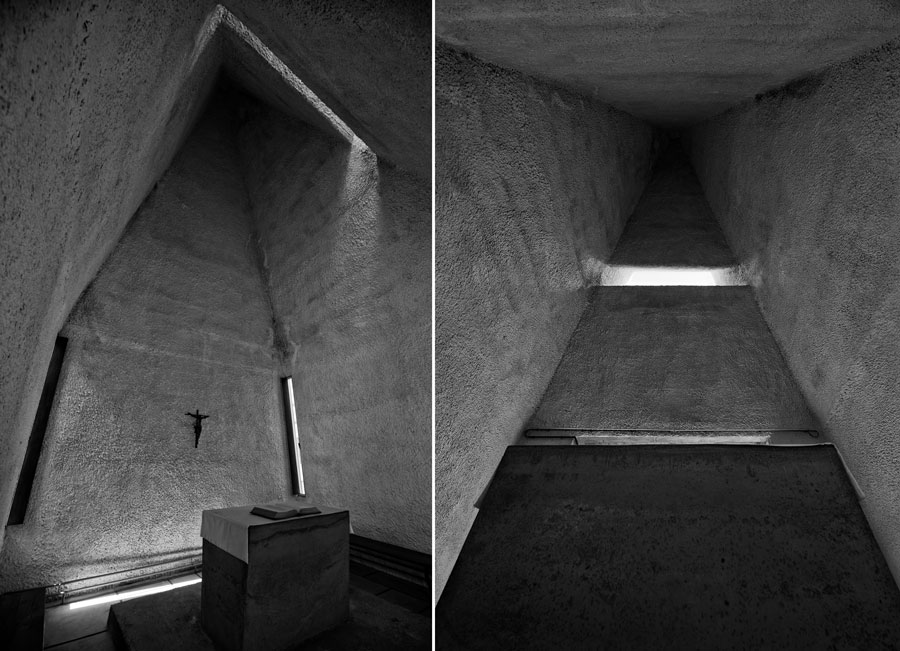
Despite its very small size, the chapel is three stories high, with a pyramidal ceiling pierced by narrow openings that diffuse zenithal light.
Please note: in the first half of 2026, donations will be sought for the restoration of the pyramidion.
The pre-meditation pathway
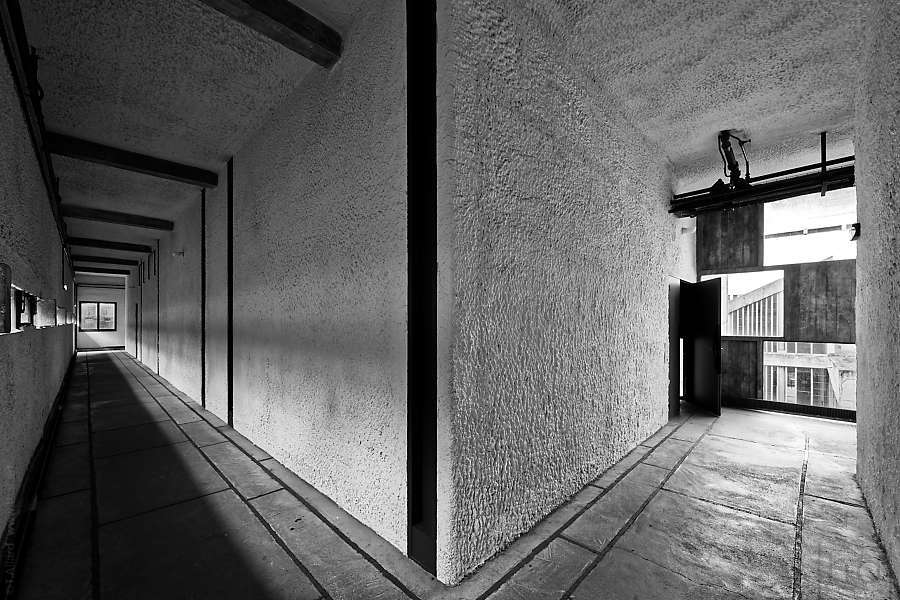
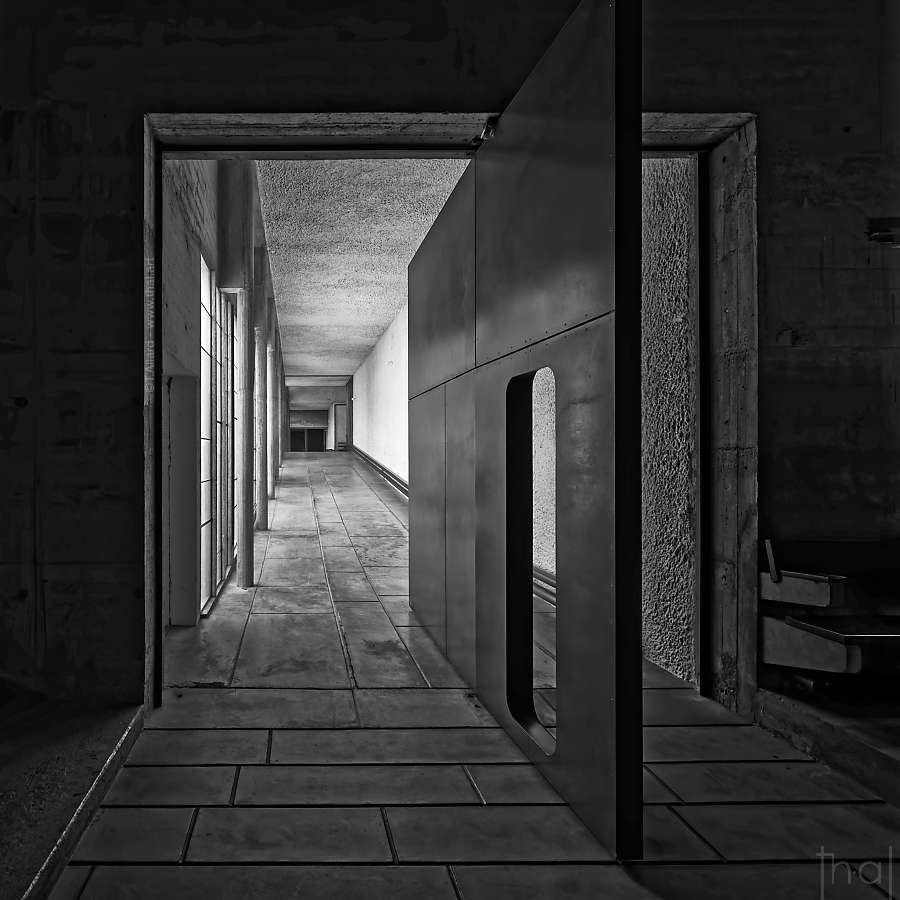
At the reception area, located on the central floor of the convent, a long corridor without doors runs along the east facade. It extends at an angle to go around a reading room and the library.
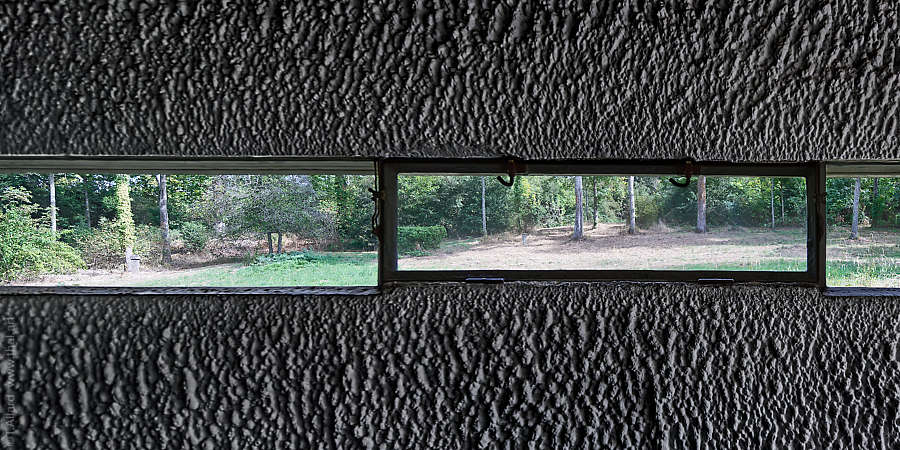
The narrow strips of glass lining the entire corridor offer a limited but cinematic view of the outside, cutting through the surrounding forest in sections.
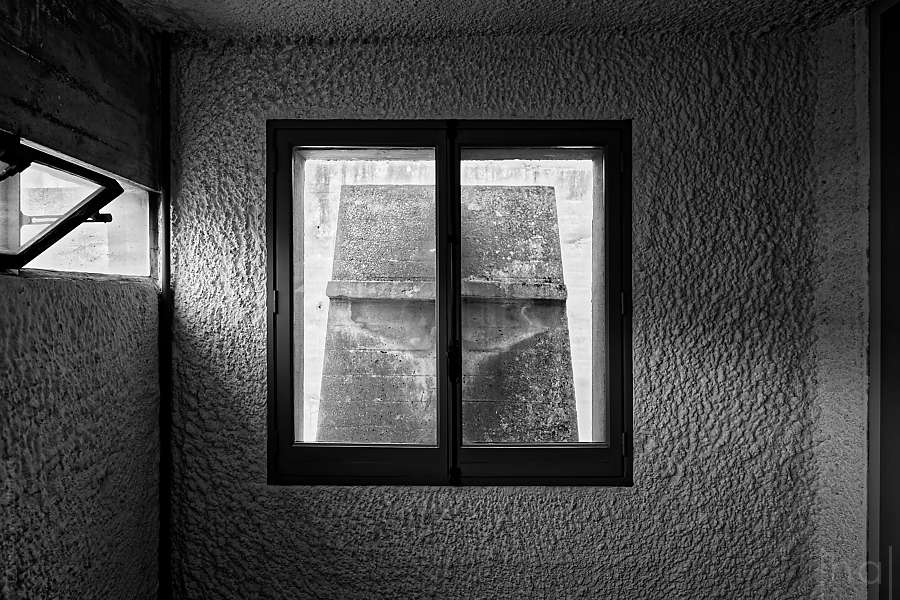
The first corner of this corridor reveals a window obscured by a sloping concrete panel.
This is one of the famous “fleurs de béton” that protrude from the exterior facades.
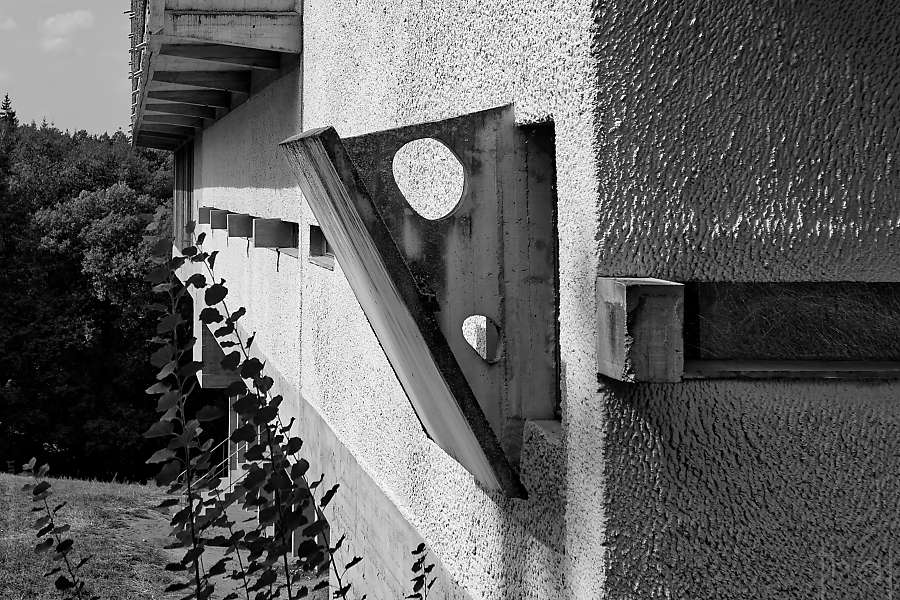
When you think about it, it’s one of the architect’s most insane concepts: building windows only to obscure them afterward—even if the goal is to foster inwardness and reduce distractions for the Dominican friar during his journey.
On the south side, the corridor becomes even narrower, preventing two people from walking side by side and effectively imposing a silent journey.
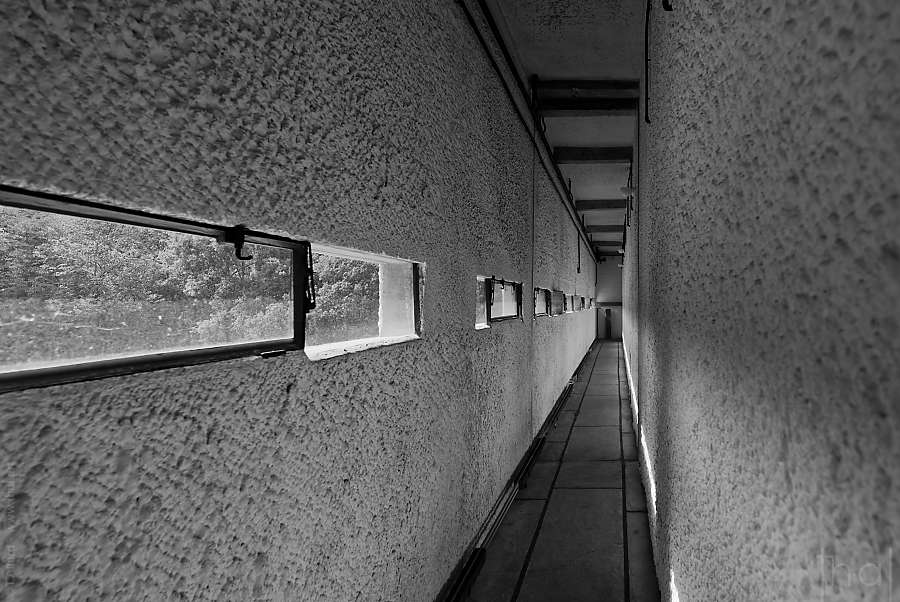
This long path leading to the convent’s most convivial spaces, such as the refectory and chapter room, is the method devised by Le Corbusier to place the Dominican friars in a reflective state.
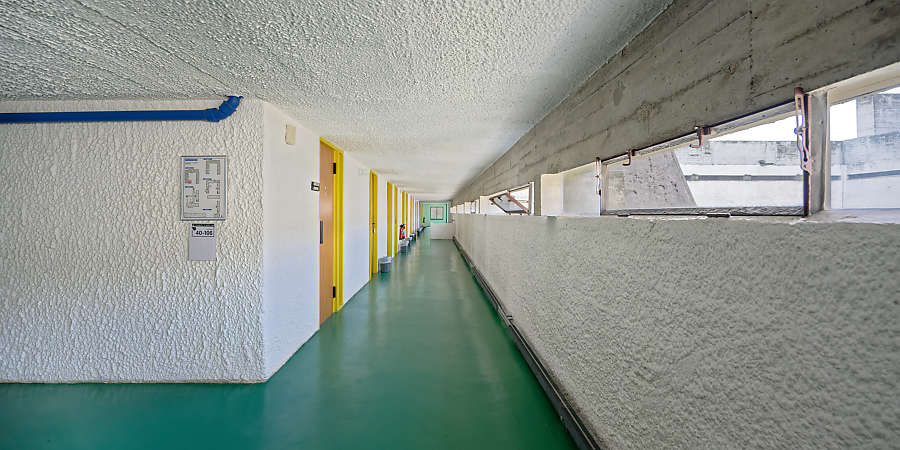
On the two upper floors, long corridors lead to the rooms in the three wings of the building, each ending once again with a covered window.
The narrow strip windows lining these corridors face the inner courtyard this time.
The roof, terrace of contemplation
The vast flat roof that covers the entire convent and church is surrounded by a 1.70-meter-high wall. This significantly reduces the possibility of appreciating the landscape and architecture of the convent.
Here, a contemplative architectural promenade logically comes to an end, to be extended by a more interior journey.
Spaces of silence
Modulor-stamped cells
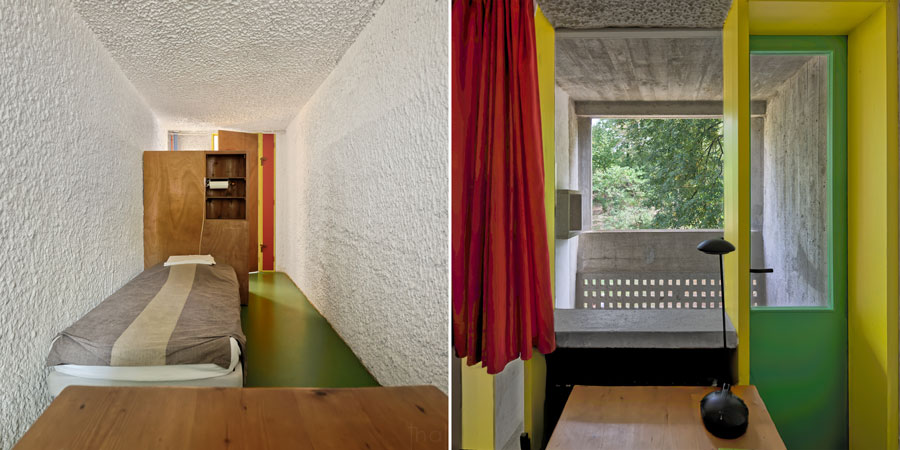
The Modulor dimensions—2.26 m for the ceiling height and 1.83 m between walls—make the 74 Dominican friars’ rooms quite narrow, well deserving their name of cells, even if they benefit from a small brise-soleil loggia as an amenity.
They are the same size as the children’s rooms in the Marseille Radiant City, built just before, and which will later be found in other “machines for living,” such as the Firminy housing unit.
The other 24 rooms reserved for the Dominican fathers are slightly more spacious, as they benefit from a “rotation” of the Modulor with arm extended to determine their width: they are thus as wide as they are tall.
All cells are identical in length at 5.92 meters, with the exception of six smaller ones reserved for the infirmary, which are not measured using the Modulor system.
The library

This space, where silence reigns supreme, is adjacent to a reading room and the small chapel mentioned earlier.
Spaces of light
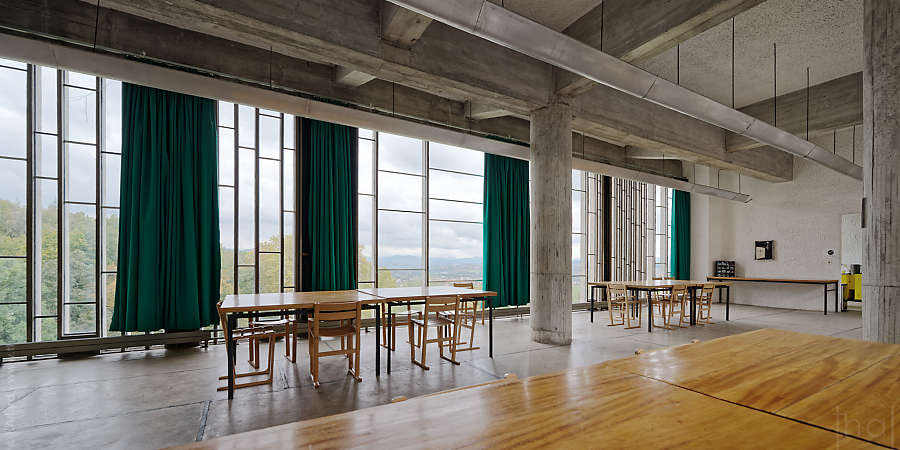
All rooms in the west wing feature undulating glass walls offering spectacular views of a lush green valley.
The chapter room
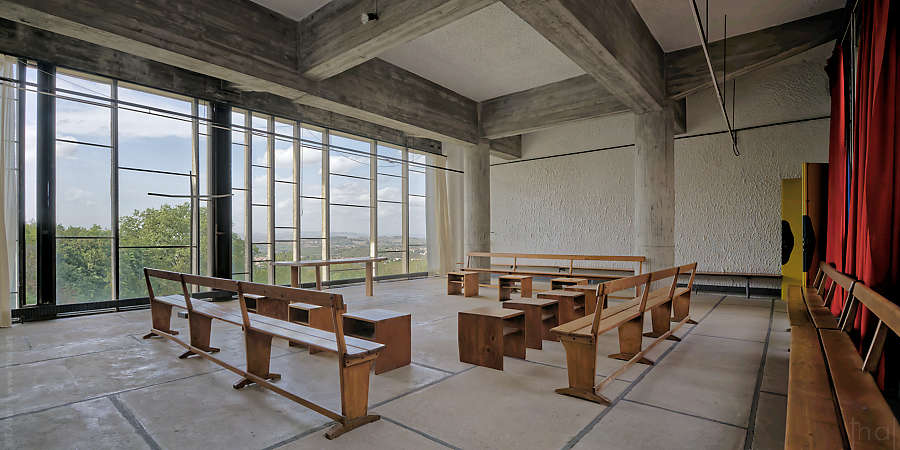
The dining hall
The polychromatic experience
At the La Tourette convent, walls painted in vivid tones appear to highlight certain parts of the church.
As for the woodwork, it is all colored, like in the Cité Radieuse built shortly before. Here, the color of the doors—red, yellow, and blue—is not linked to their floor and seems rather to correspond to their function or importance.
Another peculiarity concerns the systematic coloring (red or blue) of water inlets and outlets, visible in passageways and toilets.
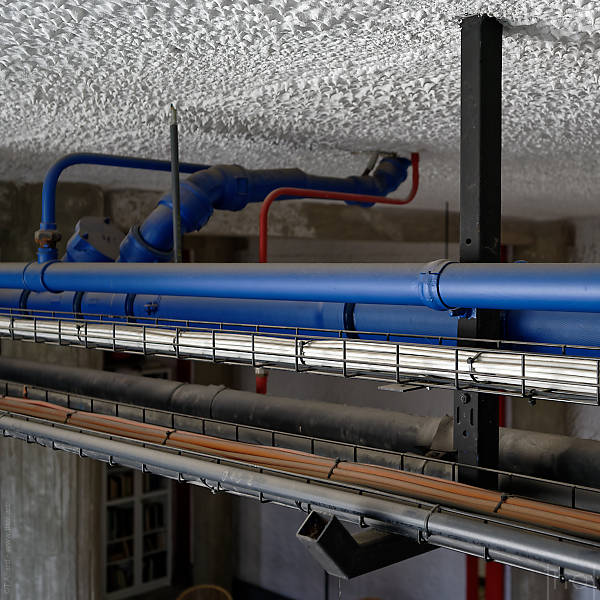
The exposed colored cable conduits and pipes running along certain walls or ceilings, the concrete left in its raw tone for the church, or the meaningful coloring of certain elements, echo the Dominicans’ motto “veritas, the search for truth.”
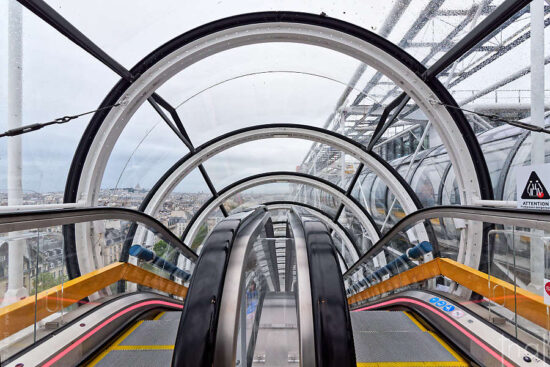
They foreshadow an idea that would be taken to its extreme twenty years later by Renzo Piano and Richard Rogers for the Centre Pompidou in Paris.
Thierry Allard
French photographer, far and wide
Please respect the copyright and do not use any content from this article without first requesting it.
If you notice any errors or inaccuracies in this article, please let me know!
You may be interested in other reports on Le Corbusier architect: